
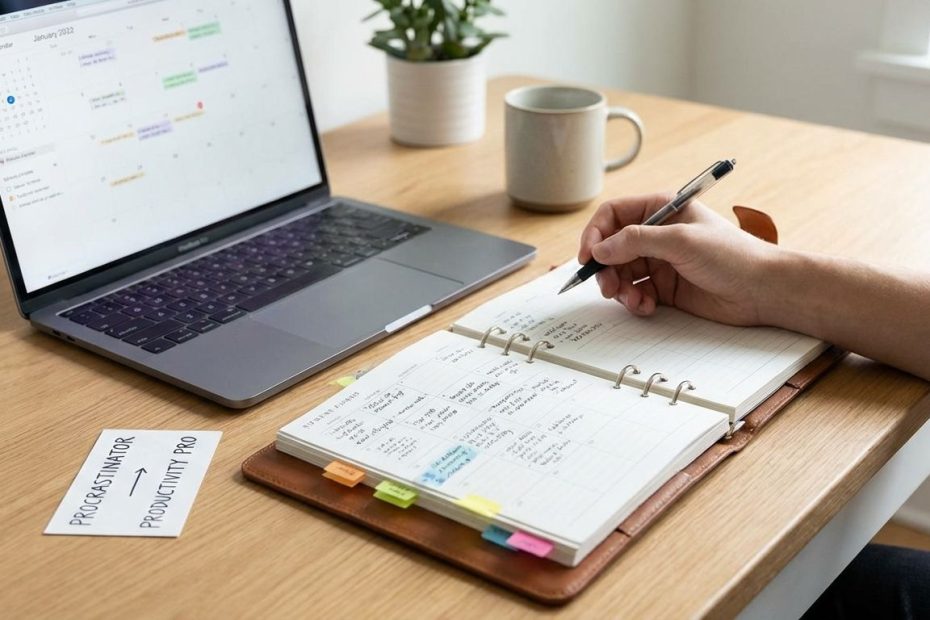
Time management for students requires shifting from relying on fleeting motivation to building friction-free systems that trigger immediate task initiation. You will discover proven methods to bypass mental roadblocks and turn chaotic academic schedules into structured, predictable routines. Mastering these exact tactics allows you to maximize academic output without sacrificing your personal life.
How Do I Stop Procrastinating And Actually Start Studying?
Procrastination acts as a strict barrier to task initiation rather than a permanent character defect. You avoid work when assignments feel massive, undefined, or heavily demanding. Shrinking the initial step reduces the mental resistance immediately blocking your progress. Attack the blank page by typing a single, poorly structured sentence. Solve exactly three math equations without worrying about the rest of the chapter. Momentum takes over instantly once you push past that initial minute of focused action.
Environmental friction dictates your failure or success before you even pull out a chair. Boot up your laptop and open the exact assignment tab you need before leaving the room for a snack. Keep necessary textbooks visible on the desk and stash gaming controllers in a separate closet. Eliminate the physical gap between your intention and your execution. Roughly 80 to 95 percent of college students battle task delay regularly regarding their coursework. Normalizing this struggle helps you drop unnecessary guilt and focus strictly on aggressive behavioral adjustments.
Measure your avoidance triggers to identify exactly when you step away from the desk. Track the specific moments you feel the overwhelming urge to quit. You will notice distinct patterns related to hunger, confusion, or poorly written instructions. Break the cycle by labeling your exact emotional state during those high-resistance moments. Acknowledge the frustration aloud to strip the emotion of its restrictive power. Direct your attention immediately back to a microscopic physical action.
Set a strict timer for two minutes and commit to working exclusively within that tiny window. Give yourself full permission to stop once the alarm sounds. You will rarely quit once your brain actively engages with the core material. Optimize your workspace to serve one singular function during scheduled study hours. Remove everything unrelated to the specific assignment you need to conquer right now. A sterile visual environment forces your brain to engage with the only stimulating item left in the room.
Recognize that motivation follows action, never the reverse. Waiting for inspiration guarantees missed deadlines and rushed, low-quality submissions. Force the initial movement, and the drive to finish will catch up shortly after. Build a pre-study ritual to signal to your brain that intense focus is required. Play a specific instrumental track or clear your desk in the exact same sequence every day. Repetition hardwires your nervous system to drop into a productive state faster.
What Is The Best Time Management System For Students?
A functional schedule relies heavily on a two-layer structure separating broad weekly planning from rigid daily execution. You need a macro view of impending deadlines paired with a narrow, hyper-focused daily priority list. A layered system prevents your brain from freezing when staring at a semester’s worth of pending assignments. Dedicate thirty unbroken minutes every Sunday to map out all academic deliverables for the upcoming week. Assign strict mini-deadlines to large projects to force early, steady progress. Draft the history outline by Tuesday to guarantee you can edit comfortably by Thursday.
Limit your morning planning routine to five brief minutes. Select one to three critical tasks that absolutely must get done today to move the needle. Assign those specific priorities to dedicated time blocks rather than keeping them floating on a passive to-do list. Tying early completion to immediate rewards alters your timeline permanently. Treat yourself to an episode of a favorite show exclusively after finishing a specific milestone ahead of schedule. Early action drastically cuts down the panic associated with midnight deadlines.
Audit your weekly time expenditure to locate hidden pockets of wasted hours. Track your activities in fifteen-minute increments for three days to expose your actual daily habits. You will uncover massive blocks of time lost to endless scrolling or unstructured lounging. Reclaim those lost hours by scheduling rest intentionally alongside your deep work. Treat downtime as a rigid, unmovable appointment on your calendar. Scheduled relaxation restores cognitive function much faster than accidental procrastination.
Treat deadlines as final cutoffs rather than loose suggestions. Build artificial urgency by moving the actual due date up by forty-eight hours on your personal planner. You create a powerful safety buffer against unexpected technical issues or sudden illness. Evaluate your daily list every evening to measure your execution rate. Carry over unfinished tasks, but penalize yourself by reducing tomorrow’s overall workload expectations. Consistent measurement highlights exactly where your time estimation skills fail.
Separate your planning phase completely from your execution phase. Figuring out what to do while you are supposed to be working depletes your limited decision-making energy. Sit down at your desk knowing exactly what requires your immediate attention. Standardize your weekly routines to minimize the daily mental load. Assign specific subjects to specific days to create a reliable, repeating rhythm. Predictability eliminates the friction of choosing what to study each afternoon.
Does The Pomodoro Technique Actually Work For Studying?
The Pomodoro technique offers massive value for task initiation and immediate distraction control. Breaking work into 25-minute sprints makes unpleasant reading assignments feel completely survivable. You commit only to a short, highly defined window rather than an endless evening of grinding. Mixed results occur when applying short intervals to highly complex, deep-thinking tasks. Constant alarms interrupt your peak concentration when writing long essays or solving heavy physics equations. Many learners discover that a rigid 25-minute timer feels far too restrictive during intense cognitive labor.
Customize the intervals to match your specific cognitive load for the day. Utilize the standard format for repetitive busywork, flashcards, or basic email management. Switch to longer 45 to 60-minute blocks when tackling heavy problem sets or original writing. Treat study timers as adjustable tools, not absolute unbending laws. Track your mental stamina across different subjects to find your ideal break rhythm. Stop the timer immediately if it creates more anxiety than actual academic output.
Utilize the structured breaks to completely disconnect from the required material. Step away from your chair, stretch your legs, and stare at objects in the distance to rest your eyes. Staying seated and switching to another browser tab ruins the restorative value of the pause. Log your completed intervals to build a visual record of your daily effort. Seeing ten successful blocks checked off on a notepad generates immense satisfaction and momentum. Gamify your study sessions to push yourself slightly further each afternoon.
Ignore the urge to skip breaks when you feel temporarily energized. Pushing through the scheduled rest periods guarantees a harsh crash later in the evening. Consistent pacing outperforms erratic bursts of extreme effort every single time. Pair the timer with a specific, measurable goal for that exact block. Challenge yourself to read exactly fifteen pages before the alarm sounds. Connecting time constraints to output quotas forces you to read faster and retain more data.
Experiment with completely different interval ratios to find your personal sweet spot. Test a 50/10 split on Mondays and a 30/5 split on Tuesdays. Let the difficulty of the material dictate the length of the sprint. Adjust your expectations based on your daily energy levels. Drop back to extremely short ten-minute intervals on days when you feel entirely drained. Doing a tiny amount of work safely prevents the zero-progress days that destroy academic momentum.
How Do I Manage Time When Overwhelmed With Multiple Classes?
Convert vague feelings of academic panic into a highly visible, actionable queue. Dump every syllabus requirement, exam date, and reading assignment onto a single master tracking sheet. Emptying your brain of floating, invisible deadlines immediately lowers your resting cortisol levels. Sort this newly created inventory strictly by due dates and overall grade impact. Do not fall into the trap of completing simple, low-value tasks just to feel temporarily productive. Target the heaviest, most demanding academic requirements first to guarantee maximum point retention.
Break massive deliverables down into the very next physical action required to progress. Labeling a task “write research paper” paralyzes you entirely. Listing “find three peer-reviewed sources on library database” gives you a clear, easily achievable target. Schedule these high-impact blocks during your absolute peak energy hours. Tackling your hardest, most confusing class right after breakfast yields far better results than leaving it for midnight. Strategic energy allocation drastically multiplies the value of your limited study hours.
Batch similar tasks together to maintain a smooth cognitive rhythm. Group all your email replies, forum posts, and administrative forms into one quick session. Switching constantly between math formulas and creative writing drains your mental battery incredibly fast. Communicate your heavy workload boundaries to friends and family members. Set strict blackout periods where you refuse to answer casual text messages or phone calls. Defending your time aggressively prevents outside requests from derailing your academic priorities.
Review your master list weekly to catch any fast-approaching deadlines you missed. Cross off completed items with a heavy marker to reinforce your sense of forward motion. Maintaining absolute visibility over your workload prevents sudden, disastrous surprises. Drop perfectionism when dealing with overwhelming, stacked priorities. Execute the work to meet the grading criteria, then move immediately to the next item.
Utilize the triage method during weeks where finishing everything becomes mathematically impossible. Calculate which assignments carry the lowest penalty for late submission or partial completion. Sacrifice the small battles strategically to ensure you win the overarching academic war. Consolidate your study materials into one centralized digital location. Wasting twenty minutes hunting for the correct PDF file destroys your momentum before you even begin. Organized folders and clear naming conventions streamline your entire workflow.
How Can I Stay Focused And Stop Getting Distracted By My Phone?
Physical distance remains the absolute most reliable method for destroying digital distraction. Leave your device in a completely different room during your dedicated study blocks. Out of sight directly translates to out of mind when dealing with constant notifications. Scrolling social media during a five-minute break completely ruins your attention span. Your brain fails to reset when you flood it with high-dopamine content between intense study sessions. Step away from your desk and physically stretch rather than reaching immediately for the screen.
Implement rigid technological barriers if physical separation feels completely impossible. Activate aggressive focus modes and place the device face down completely out of arm’s reach. Install specialized applications that lock away distracting websites until your work timer officially ends. Building sustained focus requires daily practice and incredibly firm boundaries. You train your brain to actively ignore the urge to check messages over time. Guard your attention relentlessly to cut your total required study time in half.
Establish a “hard mode” routine for your most critical final exam preparations. Lock the phone in your car or hand it to a trusted roommate for three hours. Removing the physical possibility of checking the device forces you to confront the study material. Utilize “medium mode” for standard daily homework assignments. Silence all alerts, close all unnecessary browser tabs, and leave the phone across the room. You create enough physical friction to stop the automatic, unconscious habit of picking it up.
Deploy focus-based gamification applications to make ignoring your phone genuinely rewarding. Grow digital trees or earn virtual currency strictly by leaving your screen untouched. Earning points for uninterrupted focus turns discipline into an engaging personal challenge. Identify your specific distraction triggers to preemptively block them. Notice if you grab your phone specifically when a reading passage becomes difficult to comprehend. Catching the exact moment of frustration allows you to push through the discomfort instead of escaping.
Replace the negative habit with a harmless physical action. Keep a stress ball, a pen to spin, or a glass of ice water on your desk. Give your hands something mechanical to do when the craving for digital stimulation hits. Audit your device to strip away the most aggressive attention traps. Delete highly addictive applications directly from your home screen during the semester. Forcing yourself to log in through a web browser adds enough friction to break the daily scrolling loop.
How Many Hours Should A Student Sleep To Be Productive?
Sleep acts as the foundational, non-negotiable infrastructure for cognitive performance and memory retention. Cutting rest to cram inevitably degrades your ability to recall vital information the next day. You process complex concepts and solidify active learning exclusively during deep sleep cycles. Health organizations routinely specify eight to ten hours per night for teenagers and young adults. Younger adolescents require up to twelve hours to maintain optimal, sustained focus levels. Hitting these baseline numbers consistently protects your academic stamina throughout the entire semester.
Chronic fatigue frequently masquerades as laziness or a lack of personal motivation. You avoid hard tasks simply because your brain lacks the physical energy to process them efficiently. Fixing a broken study routine often starts strictly with fixing a shattered sleep schedule. Guard your designated bedtime with the same intense ferocity you apply to major exam dates. Shut down all glowing screens a full hour before sleeping to allow melatonin levels to rise organically. Predictable, high-quality rest eliminates the daily sluggishness that leads directly to delayed assignments.
Align your most demanding study sessions with your natural biological rhythms. Target the early morning hours if you naturally wake up feeling alert and ready to process data. Stop fighting your internal clock and schedule your hardest tasks when your energy naturally peaks. Eliminate the disastrous habit of relying on caffeine to replace missing sleep. Energy drinks provide a temporary, artificial spike followed by a massive crash in concentration. Hydrate heavily with water to maintain a steady, reliable baseline of physical energy.
Establish a firm cutoff time for all academic work each night. Continuing to study past 10 PM often yields diminishing returns as cognitive fatigue severely limits retention. Closing the books at a specific hour forces you to work faster during the afternoon. Optimize your bedroom environment strictly for physical recovery. Lower the room temperature, utilize blackout curtains, and remove all work-related materials from the space. A dedicated rest environment trains your brain to shut down the moment you enter the room.
Track your sleep metrics for two weeks to identify massive gaps in your recovery. Record the exact time you turn off the lights and the moment you actually fall asleep. Adjust your evening routine based entirely on the hard data you collect. Prioritize consistent wake times over flexible weekend sleeping habits. Waking up at the exact same time every single day stabilizes your internal clock rapidly. Consistency eliminates the brutal Monday morning brain fog that ruins early-week productivity.
What Should I Do If I Procrastinate Even With A Planner?
Planners fail miserably when they only list vague outcomes instead of executable, physical actions. Writing “study biology” provides zero clear direction on where to direct your immediate focus. You will automatically ignore tasks that force you to make difficult decisions about how to start. Rewrite your daily obligations into microscopic, highly observable behaviors. Change vague goals into concrete steps like completing twenty minutes of active recall on chapter six. Specify the exact material and the exact duration to completely remove all planning guesswork.
Add strict external accountability to tasks you habitually avoid. Text a reliable classmate a photo of your completed draft outline by a specific, agreed-upon evening hour. Making your progress highly visible to others creates a healthy, productive pressure to follow through. Audit your structural system to ensure your rewards align perfectly with early completion. Build regular checkpoints into your personal calendar that trigger immediate positive reinforcement. Visualizing tangible progress generates the exact dopamine necessary to keep pushing forward.
Implement a daily shutdown routine to cleanly separate work from leisure. Spend five minutes reviewing tomorrow’s specific tasks, closing all browser tabs, and packing your bag. A definitive end to the workday prevents academic guilt from bleeding into your evening rest. Utilize visual tracking to force a sense of mounting momentum. Tape a large calendar to the wall and mark a massive red “X” for every day you study early. Breaking the chain becomes highly undesirable once you accumulate a solid week of wins.
Design your planner to capture ideas, not just rigid assignments. Create a separate section for sudden thoughts, secondary tasks, or future project ideas. Storing these distractions on paper clears your working memory instantly. Review your past performance weekly to calibrate your future expectations. Note exactly which tasks took twice as long as you originally estimated. Adjust your time-blocking strategy to reflect reality rather than overly optimistic planning.
Stop buying complicated productivity applications when a simple pen and paper work better. High-friction digital tools often become an entirely new form of procrastination. Stick to the absolute simplest system that reliably dictates your next move. Treat your written plan as a binding contract with your future self. Refuse to negotiate the terms once you lock in the daily priorities. Honoring your own schedule builds immense self-trust and destroys the procrastination habit permanently.
How Do I Stop Procrastinating Right Now?
- Identify the absolute smallest possible physical next step.
- Commit to working intensely for exactly five minutes.
- Remove your smartphone from the room entirely.
- Open the required document to eliminate starting friction.
Master Your Schedule And Reclaim Your Free Time
Taking control of your academic workload demands strict behavioral adjustments and reliable systems over raw willpower. You eliminate the friction of starting by breaking colossal projects into microscopic, actionable tasks. Structuring your weekly targets alongside non-negotiable sleep schedules guarantees high-level performance without burnout. Protect your focused blocks from digital interruptions to dramatically slash your total study hours. Executing these exact strategies immediately turns your academic stress into predictable, manageable success.
References:
- https://www.reddit.com/r/study/comments/k3uezy
- https://www.nu.edu/blog/helping-students-overcome-procrastination/
- https://arxiv.org/abs/2311.15125
- https://pmc.ncbi.nlm.nih.gov/articles/PMC12532815/
- https://pmc.ncbi.nlm.nih.gov/articles/PMC12292963/
- https://www.cdc.gov/physical-activity-education/staying-healthy/sleep.html
- https://medschoolinsiders.com/study-strategies/pomodoro-mistakes/