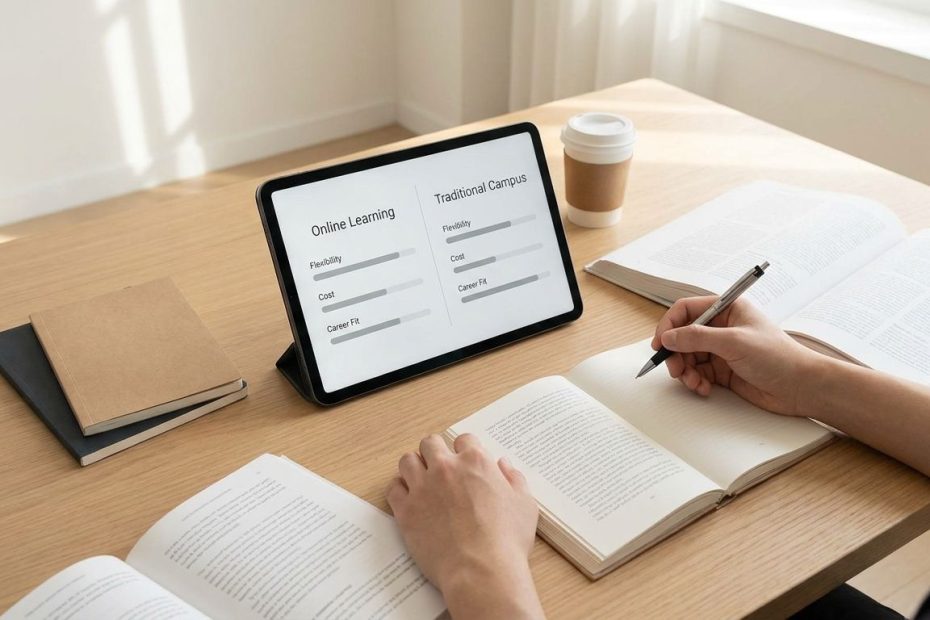
Online Degree vs Traditional College comes down to fit: choose online if you need flexibility, lower commute costs, and control over your schedule; choose traditional college if you need campus structure, hands-on facilities, and frequent face-to-face support.
Your best choice depends on your life, your major, your budget, and how you learn when no one is physically checking whether you showed up. This guide compares the pros, cons, costs, credibility, learning format, social experience, and decision criteria so you can choose a degree path that matches your goals instead of chasing the option that sounds better on paper.
Why The Online vs. Traditional College Decision Matters Now
Online learning is no longer a fringe option. Federal education data show that more than half of undergraduate students took at least one distance education course, and about one in four studied only through distance education. That means your choice is not between “real college” and “online college.” It’s between different ways of earning a credential, building skills, and reaching the next career step.
Traditional college still gives you a built-in routine, physical classrooms, campus events, labs, advising offices, libraries, clubs, and daily peer contact. Online degree programs give you access when commuting, relocation, work schedules, caregiving, or military life would make campus attendance hard. The tradeoff is direct: online learning gives you more control, but it also asks more of your time management.
The smartest way to compare Online Degree vs Traditional College is to start with your constraints. If you can attend class at set times, benefit from structure, and want a campus experience, traditional college may fit. If you’re balancing a job, family obligations, or location limits, an online program can make college possible without pausing the rest of your life.
Flexibility And Schedule: Can College Fit Into Your Life?
Online degrees usually win on schedule flexibility. Many programs use asynchronous classes, which means you watch lectures, complete readings, join discussion boards, and submit assignments within weekly deadlines. That works well if your work shifts change, you parent during the day, or you need to study early in the morning or late at night.
Traditional college gives you a fixed rhythm. You attend class at set times, see professors regularly, and move through the week with a campus routine. That structure can help if you struggle to start tasks without external pressure or if you learn better when your day has clear anchors.
The drawback of flexibility is that it can hide procrastination until deadlines pile up. Online students often name staying on track and meeting deadlines as a top challenge. If you choose online, you need a weekly calendar, a quiet study space, and a habit of checking the learning platform several times per week.
Cost Breakdown: Tuition, Fees, And Real Savings
Online degrees can cost less, but the answer depends on the school, residency rules, fees, and your living situation. Public four-year in-state tuition often sits near the lower-cost end of traditional college pricing, and public online bachelor’s programs can fall in a similar range. Some online programs charge the same tuition to in-state and out-of-state students, which can make a big difference if you’re comparing programs across state lines.
The cost advantage often comes from what you don’t pay. Online students can avoid campus housing, meal plans, daily commuting, parking, relocation, and some activity-related expenses. If you already have a job, an online degree may let you keep earning income while studying, which changes the real price of attendance.
Traditional college may still be worth the higher total cost if you need facilities that are hard to duplicate online. Science labs, clinical placements, studio spaces, performance facilities, and campus-based research can matter in certain majors. Before comparing tuition alone, calculate the full cost of attendance, including books, technology, transportation, housing, lost work hours, and required in-person sessions.
Quality And Perception: Do Employers Respect Online Degrees?
Most employers focus on accreditation, school reputation, major, skills, experience, and whether you can do the work. Employer perception of online degrees has improved, and survey data from the Online Learning Consortium with Wiley University Services found that most employers viewed online degrees as credible when compared with campus-based degrees. The word “online” is rarely the deciding factor when the institution is legitimate and the program has a good reputation in your field.
Your diploma may not always state that the degree was completed online. Many universities award the same credential to online and campus students when the academic program is housed under the same institution. That said, you should never assume this. Ask the admissions office how the degree appears on transcripts and diplomas before you enroll.
Graduate schools and employers may ask closer questions when a program is unknown, lacks proper accreditation, or comes from a school with weak academic standards. Your safest move is to verify institutional accreditation, program-level approval where relevant, faculty credentials, graduation outcomes, and career support. A respected online degree from a recognized university will usually serve you better than a campus degree from a school with poor outcomes.
Learning Environment: Structure, Interaction, And Support
Traditional college gives you immediate access to classroom energy. You can ask a question during class, visit office hours, form study groups after lectures, and get quick feedback through casual contact. If you learn by discussion, repetition, and visible accountability, that daily environment can support you.
Online learning depends more on digital communication. You may interact through video calls, email, discussion boards, chat tools, recorded feedback, and virtual office hours. Strong online programs design these touchpoints into the course, but weak ones can feel like you’re reading slides alone and submitting assignments into a portal.
Before choosing an online program, ask how often professors respond, whether tutoring is available remotely, how group projects work, and whether academic advising is offered outside standard business hours. You should also ask whether online students can use the same career services, writing center, library databases, disability support services, and alumni resources as campus students. Good support can close much of the gap between online and in-person learning.
The Classroom Experience: Asynchronous, Synchronous, Or Face-To-Face?
Online degree programs are not all built the same way. Asynchronous courses give you weekly deadlines without requiring you to log in at a specific class time. Synchronous courses require live attendance through video sessions, which can feel closer to a traditional classroom.
Hybrid or blended learning combines online coursework with some in-person meetings. This can work well for majors that need labs, clinical hours, presentations, fieldwork, or studio critique. It also gives you some campus contact without requiring a full-time commute every day.
Face-to-face classes work best when your learning depends on live demonstration, equipment, hands-on practice, or immediate feedback. Online classes work best when the subject can be taught through reading, recorded lectures, projects, writing, discussion, simulations, and guided practice. If your major has licensing requirements, clinical placements, labs, or supervised practice, confirm exactly how the program handles those requirements before enrolling.
Social Life, Networking, And Career Connections
Traditional college has a natural advantage for social life and informal networking. You meet classmates before and after class, attend events, join clubs, speak with faculty in person, and build relationships through repeated contact. Those small interactions can lead to study groups, internship tips, research opportunities, and professional references.
Online students can still build networks, but it takes more intention. You need to join virtual events, participate in discussion boards with more than the minimum reply, attend live sessions when offered, connect with classmates through professional platforms, and use career services early. Some online programs also offer virtual career fairs, alumni panels, mentoring, and group projects that mimic workplace collaboration.
If networking is a top priority, compare the school’s career services before comparing rankings. Ask whether online students can attend employer events, use interview coaching, access internship boards, and join alumni groups. A strong online program with active career support may give you better professional access than a campus program where you don’t use the resources.
Technical And Access Requirements: Is Online A Real Option For You?
Online learning requires more than a laptop and motivation. You need reliable high-speed internet, a computer that can run the school’s learning platform, webcam access for some courses, word processing software, file storage, and basic comfort with digital tools. If your internet connection fails often, online exams, live classes, uploads, and group meetings can become stressful.
Rural broadband access remains a real barrier for some students. Pew Research Center data show that a share of rural adults still lack broadband access at home, which can make fully online college harder than the brochure suggests. If that describes your situation, check whether your local library, employer, community college, or campus extension site can provide stable access.
You should also ask about proctored exams, identity verification, software fees, technical support hours, and backup options during outages. A good online program will tell you what technology you need before classes start. If the school is vague about tech requirements, treat that as a warning sign.
Retention And Completion: Which Format Helps You Finish?
The best degree is the one you can finish. Research has found that fully online programs can have lower retention than campus programs at the same institutions, though results vary by school, student group, and program design. That does not mean online students cannot succeed. It means you should be honest about your habits before choosing the format.
Online learning can work well if you are organized, self-directed, and willing to ask for help early. It can become risky if you disappear when confused, wait until the deadline to start assignments, or need face-to-face reminders to stay engaged. Traditional college gives you more visible cues: class meetings, campus routines, peer presence, and direct professor contact.
Completion support should be part of your comparison. Ask about retention coaching, advising frequency, early-alert systems, tutoring, degree planning, and how the school supports students who fall behind. A cheaper online program with weak support can cost more in the long run if you lose credits, repeat courses, or stop out before earning the degree.
How To Decide: A Practical Self-Assessment Checklist
Start with your schedule, then work outward. If you can attend classes during the day, commute reliably, and want a full campus experience, traditional college deserves serious consideration. If your life requires evening study, location independence, or the ability to keep working, online learning may be the better fit.
Then look at your major and career target. Business, communication, psychology, computer-related fields, education theory, and many humanities programs can translate well online when the program is well designed. Lab sciences, health programs with clinical requirements, performing arts, studio fields, and hands-on technical programs often need more in-person learning.
Use this checklist before you apply:
- Accreditation: Confirm the institution is properly accredited and that your program meets field-specific requirements.
- Schedule: Match class format with your work, family, commute, and study time.
- Cost: Compare tuition, fees, books, technology, housing, transportation, and lost work hours.
- Support: Check advising, tutoring, career services, library access, and professor availability.
- Career Fit: Ask employers, licensing boards, or graduate programs how they view the credential.
- Learning Style: Be honest about your discipline, need for structure, and comfort with digital tools.
Common Questions About Online Degree vs Traditional College
Is an online degree as respected as a traditional degree?
It can be, especially when the school is accredited, recognized, and respected in your field. Employers tend to care most about your skills, degree level, institution quality, and work experience.
Are online classes easier than in-person classes?
Not necessarily. Online classes can feel harder if you struggle with deadlines, reading load, independent study, or digital communication. The academic level should match the same course taught on campus when the program is built with equal standards.
Can online students get financial aid and career support?
Many accredited online degree programs qualify for financial aid, and many universities provide online students with advising, tutoring, library access, and career services. You should confirm eligibility, fees, and service access directly with the school before enrolling.
Is An Online Degree As Good As A Traditional Degree For Getting A Job?
- Yes, if the school is accredited.
- Employers often value field, skills, and reputation most.
- Online suits disciplined learners.
- Campus suits hands-on support and networking.
Choose The Degree Path You Can Finish And Use
The Online Degree vs Traditional College choice should start with fit, not assumptions. Online degrees can save time, reduce commuting, and help you study around work, but they demand planning and self-discipline. Traditional college offers structure, campus relationships, and easier access to hands-on learning, but it can cost more and require more schedule control. Compare accreditation, total cost, course format, support services, career access, and your own habits before choosing. The right option is the one that lets you earn a respected credential, build usable skills, and keep enough momentum to graduate.
References
- National Center For Education Statistics — distance education enrollment data.
- College Board — college pricing and tuition data.
- Online Learning Consortium — employer perception research on online degrees.
- Aslanian Market Research / Encoura — online student motivation and challenge findings.
- BestColleges — student survey data on networking and online learning.
- Bureau Of Labor Statistics — earnings by educational attainment.
- Pew Research Center — broadband access data.
- Educational Psychology Review — research on online and in-person learning outcomes.
- U.S. News & World Report — online bachelor’s program cost data.